







There Is No Free Lunch – But There Can Be Tax-Free Lunch
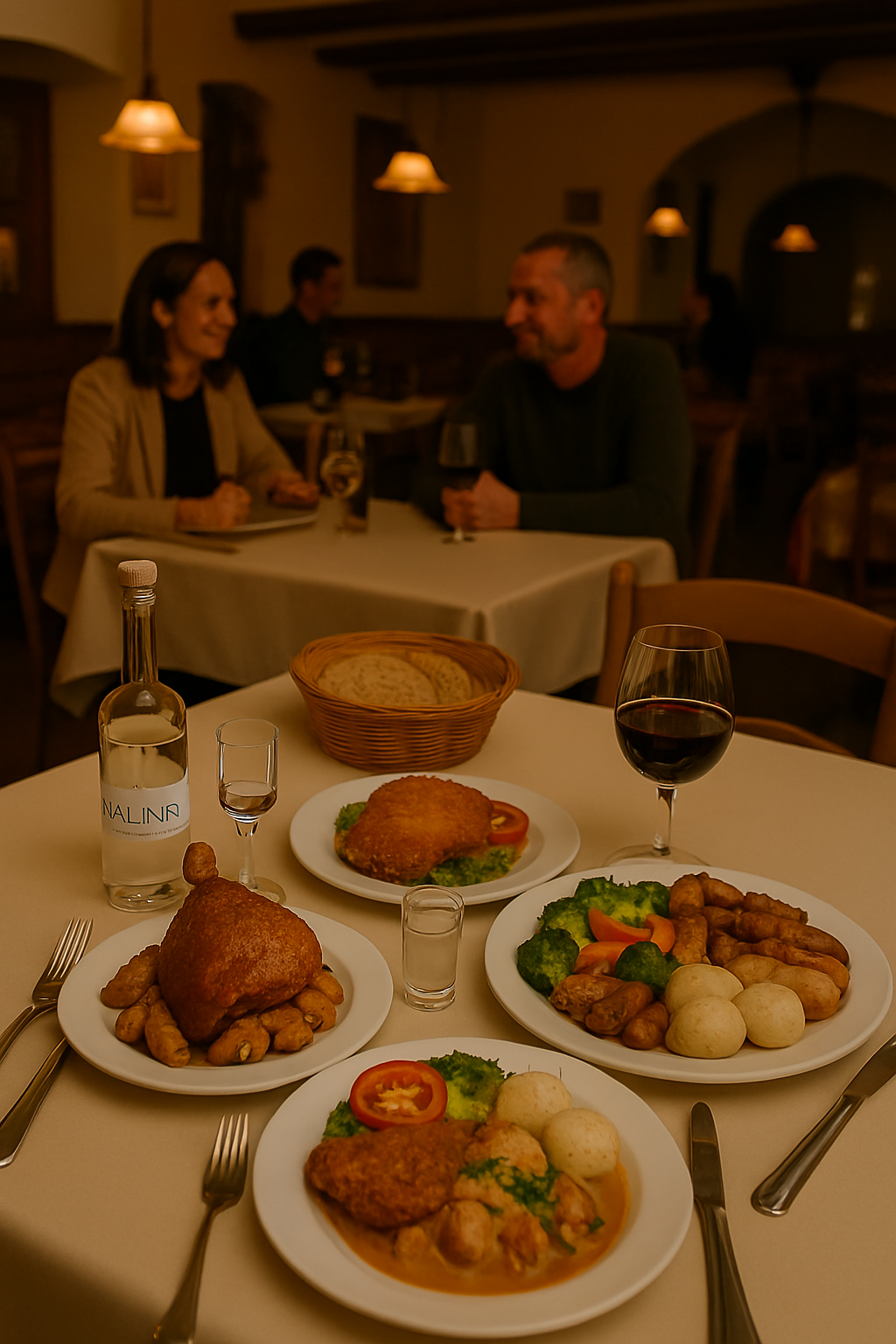
In fact, even Pálinka may be provided tax-free. Government Decree 10/2026 (I. 30.) on measures to improve the competitiveness of restaurants (hereinafter: Gov. Decree 10/2026) was published in the Hungarian Gazette on 30 January 2026 and, under certain conditions, provides tax exemption for representation provided in restaurants, sets a favourable rate for the tourism development contribution, and also grants tax exemption for gifting pálinka.
Naturally, tax exemption comes with conditions—let’s review the relevant rules.
Tax-Exempt Representation
Under Gov. Decree 10/2026, the part of the income (i.e., value of the benefit) determined based on representation provided in the form of hospitality (food, drinks) in a restaurant that does not exceed 1% of the total annual revenue accounted for in the tax year, but up to a maximum of HUF 100 million, is exempt from personal income tax and social contribution tax applicable to certain specified benefits.
A provider who begins or ceases their activity during the year may apply the threshold proportionally to the number of days of operation.
If during the tax year the income determined based on representation provided in the form of restaurant hospitality exceeds HUF 100 million, the provider must establish, declare, and pay a tax advance on the excess amount as an obligation of the quarter that includes the month of providing the benefit. A provider starting activity mid-year is not required to pay tax advances.
Since the criterion relating the threshold to 1% of revenue is based on total revenue accounted for in the current tax year rather than the previous one, it can only be determined after the end of the year whether the business has exceeded the limit. Therefore, the regulation provides that tax obligations arising on the portion exceeding the threshold must be established after the date set for determining the total annual revenue, and must be declared and paid—taking into account tax advances paid during the year—on the ’08 return by the 12th day of the quarter following the month in which the total annual revenue was determined (for the 2026 tax year: for calendar-year taxpayers, by 12 July 2027).
Although Gov. Decree 10/2026 entered into force on 1 February 2026, the rules on tax-exempt representation may be applied to the entire 2026 tax year.
For the purposes of the regulation, a restaurant is a hospitality establishment registered by the local commercial authority as the establishment type listed under point 1 of Annex 4 to Government Decree 210/2009 (IX. 29.) (hereinafter: Gov. Decree 210/2009). These are the hospitality venues where service is traditional or self-service, using reusable dishes (plates, glasses, etc.). The venue must have a guest area and allow on-site consumption. Food must be prepared on site and the establishment must have a kitchen.
Hospitality venues classified into other categories by Gov. Decree 210/2009 (such as buffet, confectionery, café, bar, pub, wine bar, music and dance venue, workplace/public catering, fast-food restaurant, event catering, occasional or mobile catering) do not meet the criteria, so the exemption does not apply to them.
For accountants, it may be difficult to determine whether the invoice relates to a service provided in a venue qualifying as a restaurant under the above definition, since the name alone does not necessarily reveal whether the place has its own guest area or, for example, guests are seated in a shared shopping-mall space, nor whether the venue has its own kitchen. A practical solution—if the restaurant is cooperative—could be that the invoice includes a note stating that the venue qualifies as a restaurant under point 1 of Annex 4 to Gov. Decree 210/2009.
Based on the expression “in a restaurant,” the exemption presumably cannot be applied where the venue meets the definition of a restaurant but the guest does not consume food or beverages on the premises but instead takes them away or has them delivered.
The phrase “representation provided in the form of hospitality (food, drink)” does not clearly indicate whether the exemption applies strictly to the price of the food and drink or whether it also extends to service charges.
However, the exemption clearly does not apply to cases that do not fall within the definition of representation under Section 3 point 26 of the Personal Income Tax Act (Szja tv.). Thus, for example, a company dinner connected to a team-building event still cannot benefit from tax exemption.
2% Tourism Development Contribution
Under the new rules, the rate of the tourism development contribution related to hospitality services provided by restaurants defined under point 1 of Annex 4 to Gov. Decree 210/2009 is 2%.
This reduced tourism development contribution qualifies as de minimis (state aid).
The preferential rate applies only to restaurant hospitality; there is no such rule for accommodation services. Therefore, if a hotel restaurant meets the definition above, a 2% contribution applies to restaurant hospitality, while accommodation services remain subject to the 4% contribution.
The 2% rate must first be applied to returns relating to the tax assessment period including the entry into force of Gov. Decree 10/2026. Since the decree entered into force on 1 February 2026, this means that monthly filers cannot apply the reduced rate for January. Interestingly, for quarterly and annual filers, the regulation does not explicitly state that the 2% rate applies only to transactions performed on or after 1 February—although this would be the logical interpretation.
Tax-Exempt Pálinka
Under Gov. Decree 10/2026, personal income tax and social contribution tax do not apply to the provision—within representation or non-representation hospitality, or as a business gift or low-value gift—of an alcoholic product produced in a tax warehouse defined in Section 3 (1) point 4 of the Excise Act of 2016 (Act LXVIII), purchased directly from the tax warehouse, and bearing a pálinka tax stamp, provided that the provider maintains records from which both the source of acquisition and the manner of use can be determined.
The exemption applies exclusively to pálinka purchased directly from a tax warehouse—it cannot be applied to purchases from wholesalers, retailers, or webshops. To avoid disputes during a tax inspection, it is advisable to document already at the time of purchase that the seller is a licensed tax warehouse operator (e.g. by including their license number on the invoice and verifying its validity) and that the sale was made directly from the tax warehouse.
VAT and Corporate Income Tax
Gov. Decree 10/2026 contains favourable rules only with respect to personal income tax, social contribution tax, and the tourism development contribution. The underlying VAT and corporate income tax rules remain unchanged.
Therefore, VAT on hospitality services used for representation and VAT on pálinka purchased for free-of-charge distribution remains non-deductible (the exemptions do not override the existing deduction ban).
Representation under the Personal Income Tax Act continues to qualify as a cost incurred in the interest of business activities under Annex 3, Part A, point 16 of the Corporate Income Tax Act (Act LXXXI of 1996). This also applies in respect of tax-exempt representation since there is no contrary legal provision.
If you have any further questions regarding this topic, please feel free to contact our experts.